Tenants' Rights: Damp and Mould in UK Rental Properties (The Ultimate 2026 Guide)
By Lex
Last updated: January 2026
Welcome to Great Britain. The land of Shakespeare, The Beatles, and unfortunately, black mould that seems to have more rights to your flat than you do.
If you are reading this, you are likely all too familiar with the situation: you spot a dark, ominous patch in the corner of the bedroom, you flag it to your landlord, and you receive the classic response: "You're just breathing wrong, mate. Open a window and stop drying your socks on the radiator".

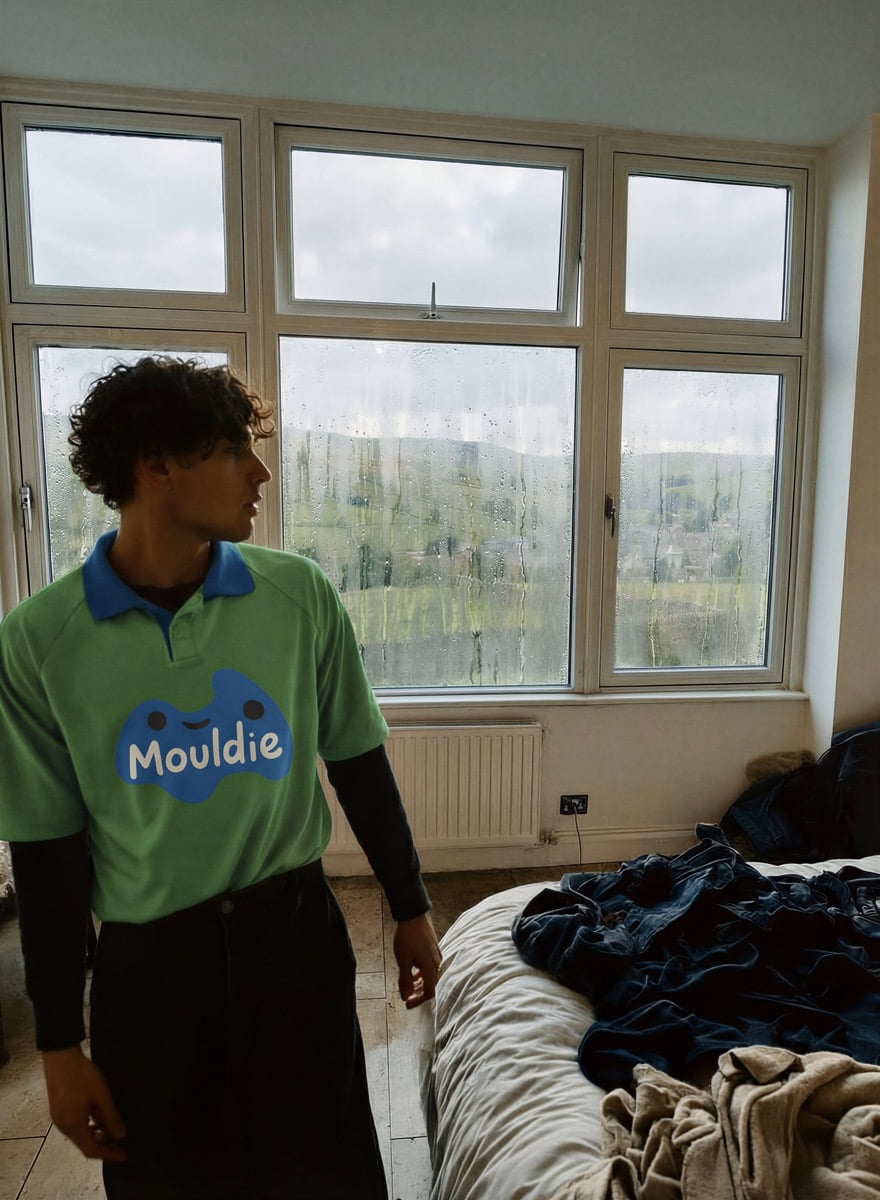
This is gaslighting, pure and simple. And at Mouldie, we are here to put a stop to it.
This article isn't just a list of tips. It is your legal shield. It is the most comprehensive deep-dive research into damp and mould rental property UK issues you will find on the internet. We will cover everything: from the biology of spores to the intricacies of Awaab's Law, from how Environmental Health actually works, to why our free tool might just be your best weapon in a dispute.
Check whether your building is structurally prone to damp and mould.
Check Your Property Risk — FREEPut the kettle on (best keep it hot to stay warm in that damp flat) and let's dive in.
Part 1: Know Your Enemy. What are Damp and Mould, really?
Before fighting for your rights, you need to understand exactly what you are dealing with. Many landlords will try to convince you that mould is just "a bit of dirt". It isn't.
Black Mould is not just "unsightly"
When we talk about black mould rental UK, we are usually referring to Stachybotrys chartarum. This is a toxic fungus that releases mycotoxins. It is not a cosmetic defect like a scuff on the wall; it is a living organism that is eating your home and potentially damaging your health.
Types of Damp in British Homes
To win an argument with a landlord, you must speak the correct language. There are three main types of damp:
| Type of Damp | What Is It? | Who Is Responsible? | The Verdict |
|---|---|---|---|
| Rising Damp | Moisture travels up the walls from the ground. Usually caused by a missing or failed Damp Proof Course (DPC). | 100% Landlord | You cannot cause this by "failing to ventilate". It is a structural failure. |
| Penetrating Damp | Water getting in from the outside through holes in the roof, cracks in the brickwork, or leaky gutters. | 100% Landlord | This is a clear structural disrepair issue. No debate needed. |
| Condensation | Moisture from the air settling on cold surfaces. The "grey area" landlords love to blame on cooking or drying clothes. | It Depends (Often Landlord) | Nuance: Landlords will say it's your fault. HOWEVER, if the property lacks adequate ventilation (fans, trickle vents) or insulation, it is legally their responsibility. |
How does Mouldie help here? You aren't a building surveyor, and your landlord relies on that fact. Mouldie changes the dynamic completely. You simply enter your postcode, select your specific address, and our AI tool generates a report powered by official UK EPC data. We analyse the building's energy DNA — insulation levels, glazing type, wall construction. We might flag: "Hold on, this property has an EPC rating of E and uninsulated solid walls". This transforms your complaint from "I feel like it's damp" to "I have official government data proving this building is structurally incapable of retaining heat".
Part 2: The Legislation. Who is to blame and what does the law say?
The question "Do landlords have to fix mould in the UK?" has only one answer: YES. But to force their hand, you need to quote the right acts. Bookmark this section.
1. Landlord and Tenant Act 1985 (Section 11)
This is the "granddaddy" of housing laws. Section 11 clearly states that the landlord is implied to keep in repair and proper working order:
- The structure and exterior of the dwelling-house (walls, roof, windows).
- Supply of water, gas, and electricity.
- Drains, gutters, and external pipes.
If the mould is caused by a leak in the roof or a crack in the wall, it is a direct breach of Section 11. The landlord is legally obliged to carry out repairs.
2. Homes (Fitness for Human Habitation) Act 2018
This act changed the game. It mandates that a property must be "fit for human habitation" at the start of the tenancy and remain so throughout.
What makes a home "unfit"? The Act lists 29 hazards, and Damp and Mould growth is one of the most serious. If mould renders your flat unsafe for your health, the landlord is in breach of contract — even if the mould isn't caused by a broken pipe, but simply by the building's terrible design or ventilation.
3. Housing Health and Safety Rating System (HHSRS)
This is the scoring system used by Council inspectors. They classify risks into:
- Category 1 Hazards: serious threats to life or health (death, permanent loss of consciousness, severe respiratory disease). Black mould frequently falls into this category.
- Category 2 Hazards: less serious, but still dangerous issues.
If an inspector finds a Category 1 Hazard, the Council must take action.
Part 3: Awaab's Law. A New Era for Tenants' Rights
You may have been searching for "What is Awaab's Law". It is the most significant shift in housing legislation in recent years.
The Tragedy that Changed Everything
The law is named after Awaab Ishak, a two-year-old boy from Rochdale who tragically died in 2020 from a severe respiratory condition caused by prolonged exposure to mould in his social housing flat. His parents had complained for years but were ignored and blamed for their "lifestyle".
What does the Law require?
Awaab's Law sets strict deadlines for Social Landlords (Councils & Housing Associations):
- Investigate: they must investigate the problem within 14 days of the complaint.
- Repair: if a health hazard is found, repairs must begin within 7 days.
- Emergency: if the risk is critical, action must be taken within 24 hours.
Does this apply to Private Renters?
Right now — technically no. The law was written for the social rented sector. BUT: the government is actively pushing the Renters' Rights Act, which aims to extend the "Decent Homes Standard" to the private sector. Furthermore, courts and Ombudsmen are now using the precedent of Awaab's case when judging private landlords. The tolerance for "it's just condensation" excuses has dropped to zero.
Part 4: The War on "Condensation". Destroying the Landlord's Argument
This is the most common scenario. You: "The wall is black with mould". Landlord: "That's condensation. You're drying clothes / breathing too much / boiling soup. Buy a dehumidifier".
Why the Landlord is often wrong
Yes, tenants must act reasonably (heat and ventilate). But the law states that a property's ventilation system must be capable of handling normal day-to-day living. Taking a shower is normal. Breathing is normal. Cooking dinner is normal.
If you are doing normal things and the walls are wet, that is a structural issue:
- Insufficient insulation (cold bridges)
- Broken or missing extractor fans
- Blocked air bricks
- Old windows lacking trickle vents
How to prove your case?
This is where Evidence is king. Landlords fear paperwork.
- Buy a Hygrometer. It costs £5-10 on Amazon. Photograph the humidity levels.
- Keep a Diary: "Ventilated for 30 mins at 09:00, heating on at 20°C".
- Use Mouldie. Our algorithm helps assess if there are signs of structural defects. When you send your landlord a structured report with facts rather than just an emotional text, the tone of the conversation changes. We help frame the problem in the language that bureaucrats understand.
Part 5: Health Risks. Why You Cannot "Just Live With It"
Black mould health risks in rentals are not a joke. Beyond the nasty smell, mould spores actively attack your system.
Who is at risk?
- Babies and children (their lungs are still developing).
- The elderly.
- Asthmatics and allergy sufferers.
- Immunocompromised individuals.
The Symptoms:
- Persistent runny nose, coughing, sneezing.
- Eye and skin irritation.
- Exacerbation of asthma.
- Fatigue and headaches.
In the UK, there is a concept of "Mould baby rented property" urgency. If you have a young child, the Council and courts view your case as a priority. A home that is "slightly uncomfortable" for a healthy adult can be legally "unfit" for a child.
Part 6: Step-by-Step Guide. What if the Landlord Ignores You?
Here is your battle plan. Follow it religiously.
Step 1: The Formal Complaint
Stop calling. Stop WhatsApping (or at least duplicate everything via email). You need a Paper Trail. Write an email:
- Describe the issue clearly.
- Attach photos (use a ruler for scale).
- Mention the impact on your health.
- Give a reasonable deadline (e.g., 14 days for a response).
Pro Tip: Use the phrases "This is a health hazard" and "Risk to human habitation". These are legal triggers.
Step 2: Contact Environmental Health
If the landlord ghosts you or says "buy some mould spray", it is time to search for environmental health damp mould on your Local Council's website.
How it works:
- Find the "Report a repair" or "Private Housing Team" page.
- Submit a complaint. State clearly that the landlord is not engaging.
- The Council may send an EHO (Environmental Health Officer).
- If the EHO finds a hazard, they will issue an Improvement Notice. This is a legal order the landlord cannot ignore without facing prosecution.
Step 3: Legal Action
If even the Council is slow (which, sadly, happens), you can sue for a housing disrepair claim. Many law firms work on a "No Win, No Fee" basis. You can claim for repairs, compensation (for ruined belongings, stress, illness), and potentially a rebate on rent paid.
Part 7: The Money Question. Can you withhold rent because of mould?
We have arrived at the most dangerous question: "Can I stop paying rent because of the mould?"
The short answer: NO. Do not do it.
It sounds unfair. Why pay for a house you can't live in? But English law is brutal here. Rent and repairs are two separate legal obligations.
What happens if you stop paying:
- You breach your tenancy agreement.
- The landlord gains mandatory grounds to evict you for arrears (Section 8 notice), even if they are breaking the law on repairs.
- Eviction for arrears destroys your credit rating and ability to rent in the future.
The Exception (Procedure of Set-Off):
there is a very complicated mechanism where you pay for repairs yourself and deduct it from the rent. BUT:
- You must notify the landlord in advance.
- You must provide 3 quotes from builders.
- You must give the landlord a final chance to do it themselves.
- The risk of getting this wrong is high. Do not attempt this without professional legal advice.
The Alternative: keep paying rent and sue for compensation later. You remain the "model tenant," and the landlord remains the "rogue".
Part 8: The Risk of Revenge Eviction
Many tenants are scared to complain because they think: "He'll just kick me out". This is called Retaliatory Eviction.
Good news: The Deregulation Act 2015 protects you if you have an Assured Shorthold Tenancy (AST). If you complain to the Council, and the Council issues an Improvement Notice, the landlord is legally blocked from serving a Section 21 ("no-fault eviction") notice for 6 months.
This is why getting Environmental Health involved is safer than just arguing via text message. That official piece of paper is your insurance policy against eviction.
Part 9: How Mouldie Changes the Game
We built Mouldie because we were tenants ourselves. We know what it's like to sleep in a room that smells like a cellar while receiving emails about rent increases.
The traditional route is expensive. A private surveyor costs £300-£500. Most tenants cannot afford that.
Mouldie — free damp and mould risk checker for UK tenants makes professional expertise accessible.
- Simplicity: enter your postcode, choose your address.
- Authority: our AI tool analyses official UK government EPC data.
- Result: you get a report that exposes the building's thermal flaws. It is a psychological weapon. When a landlord sees a document citing official energy ratings, lack of cavity wall insulation, and poor glazing, they realize their "open a window" excuse won't stand up in court.
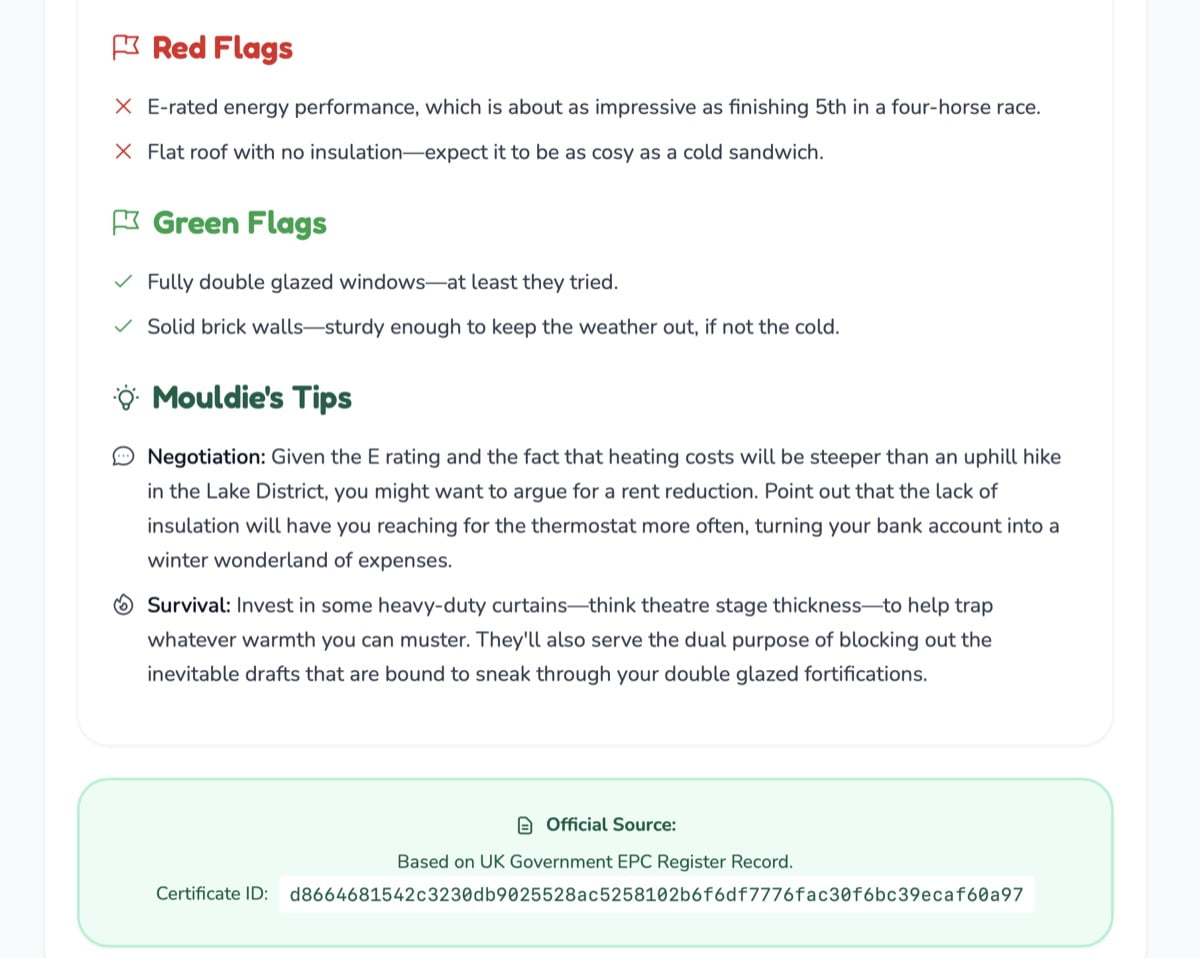
We aren't a law firm, but we give you the tools to defend yourself (or the data to help you find the right lawyers).
FAQ: Quick Answers (People Also Ask)
How long does a landlord have to fix mould?
The law says "reasonable time". Usually, this means up to 28 days. If there is a health risk, it must be faster. Social landlords (Awaab's Law) must start repairs in 7 days.
Can I move out because of mould?
Only if the landlord agrees to a "Surrender of Tenancy". If you just leave, you are liable for rent until the contract ends. Exception: If the Council deems the property "Unfit for Habitation" and issues a Prohibition Order.
Is mould classed as a health hazard?
Absolutely. It is one of the 29 official HHSRS hazards.
Can a landlord blame condensation for mould?
They will try. But remember: structural ventilation is their responsibility. If the windows are ancient, there are no fans, and the walls are freezing — that is not your fault, even if it is "condensation".
How to get rid of mould in rented property temporarily?
You can use chlorine sprays (mould remover), but this is only cosmetic. If you don't fix the source of the moisture (leaks, cold walls), it will return in two weeks. Do not paint over mould! It just hides the problem and will annoy the landlord later.
Conclusion: Your Home Should be Your Castle, Not a Petri Dish
Dealing with damp in Britain is practically a national sport. But the rules of this sport have changed. Tenants are no longer powerless.
The law is on your side. Public opinion is on your side. And now, you have technology on your side. Do not let your landlord ignore your rights. The mould is not your fault. It is a problem with the building you pay a fortune to live in.
Ready to take action? Don't wait until asthma becomes your new roommate. Check your damp and mould risk for free with Mouldie and generate the report that will make your landlord listen.
Stay dry, stay safe.
Disclaimer: this guide is for informational purposes only and does not constitute legal advice.
Use our free tool to get an instant damp and mould risk assessment powered by official UK EPC data.
Run a Free Property Check